

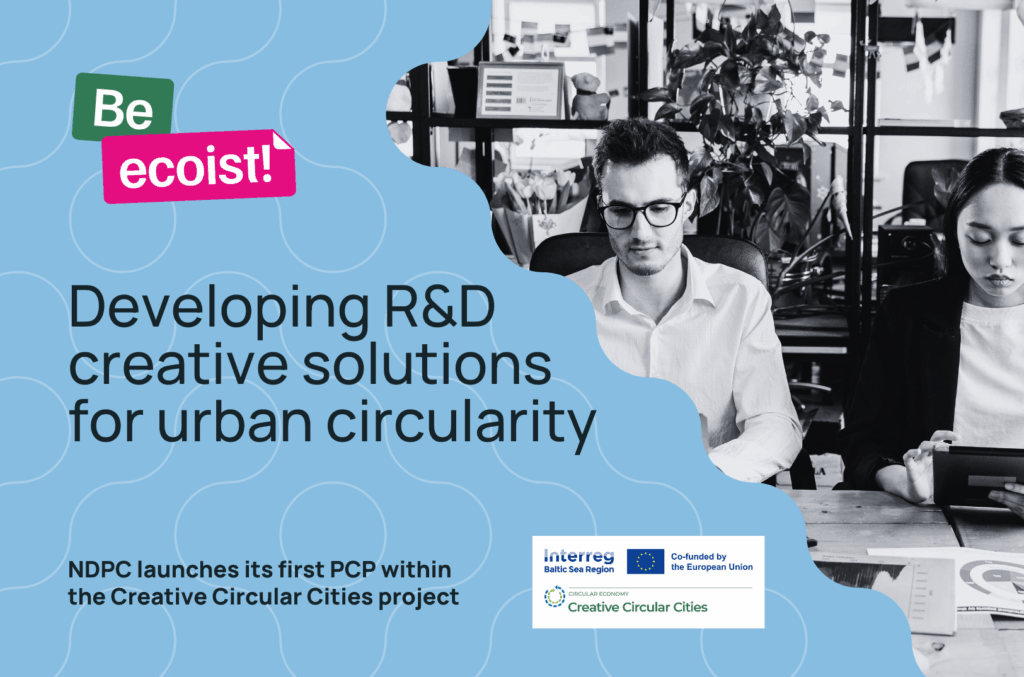
NDPC leads a pioneering PCP process to develop R&D creative solutions for urban circularity
Introduction
The Creative Circular Cities (CCC) project is taking a major step forward in accelerating local circular transformations. Driven by the NDPC and building on months of collaboration with civil society, businesses, and public-sector actors, the six participating cities—Riga, Tallinn, Turku, Gdynia, Kiel, and Aarhus—have identified key challenges where new thinking from the cultural and creative sector can make a real difference.
To turn these insights into action, the project has now launched an open call for a Pre-Commercial Procurement (PCP)—an innovation-driven process designed to bring ambitious, not-yet-on-the-market ideas closer to reality. Through this call, we are now searching for creative Research and Development (R&D) service providers who can help cities design, prototype, and test new solutions that make circular lifestyles easier and more accessible for everyone.
This marks an exciting milestone for the project and a pioneering moment for the region. Proposals are welcome until 30 December 2025, and you can learn more about the challenges, expectations, and PCP processes below.
What is a PCP? And what makes it an innovative practice for public organizations?
A Pre-Commercial Procurement (PCP) is an EU-recognized, structured process that public authorities use to procure R&D services, rather than already-market-ready products. This process is designed to stimulate innovation, reduce market failures, and help public institutions access solutions that do not yet exist but are urgently needed. The innovative part of a PCP is that it does not purchase a final product. Instead, it buys the services that gradually shape an innovative prototype into a tested, near-market solution.
Where does the need come from?
It stems from the fact that public authorities often face challenges that traditional procurement simply cannot solve. Sometimes the solution they need does not exist on the market; other times, innovation stalls because companies are reluctant to invest in high-risk R&D without a clear demand. And even when promising ideas appear, a public institution cannot freely commit to purchasing unproven technologies, leaving it with limited options.
This is where Pre-Commercial Procurement (PCP) becomes essential. PCP offers a structured way for public buyers to stimulate innovation by funding several companies to work on competing approaches at the same time. So, instead of betting on a single supplier or a ready-made product, buyers support the parallel development of alternative solutions, compare them as they evolve, and reduce risks while pushing R&D forward. The result is higher quality, more creativity, and accelerated progress.
Inside a PCP process: Learn more about the details
A PCP follows a clear, phased process. Each stage narrows down the field, ensuring that only the most promising ideas move forward.

The journey begins long before the call for tender is published. In the preparation phase, public buyers identify their unmet needs, consult the market, refine technical and functional requirements, and design the PCP tender, with tools such as an Open Market Consultation, hosted by the NDPC back in June 2025 (learn more here: https://ndpculture.org/news/creative-circular-cities-open-market-consultation-omc-will-happen-on-30-06-1300-1500-eet/)
Once launched, the process unfolds in three competitive R&D phases:
Phase 1 – Exploration of the new solution:
Several suppliers are contracted to produce feasibility studies, concept designs, and initial technical approaches.
Phase 2 – Developing the prototype:
A smaller group is selected to build and demonstrate functioning prototypes under controlled conditions.
Phase 3 – Development and testing of the original solution:
Only the strongest candidates continue to develop pre-series versions of their solutions. These are tested in real-life environments—often directly in the participating cities or institutions.
The PCP ends once the solutions have been tested. Because EU rules require a strict separation between R&D and commercial deployment, if the buyers later wish to adopt a fully developed solution, they may launch a separate Public Procurement of Innovative Solutions (PPI) tender.
Why is launching a PCP a milestone for NDPC?
Launching a Pre-Commercial Procurement (PCP) is a significant achievement for NDPC for several reasons!
1. PCPs are extremely rare in Latvia—and we are now among the pioneers.
Fewer than ten PCP processes have ever been launched in Latvia. PCP is still a very new, innovation-driven procurement method, designed specifically for situations where needed solutions do not yet exist on the market or are disproportionately expensive.
2. This is the first time an Interreg co-funded project launches a PCP.
Our project is the first-ever Interreg initiative to implement a PCP process. This meant designing a procurement model with multiple co-funders across the Baltic Sea Region, without any previous blueprint to follow. NDPC and partners have effectively acted as trailblazers, building a cross-border PCP structure from the ground up.
3. NDPC had no prior experience—making this a capacity-building breakthrough.
Since PCPs are still underused and unfamiliar to most public-sector actors, NDPC entered this process without prior implementation experience. Setting up the PCP has therefore strengthened our organizational know-how in innovation procurement and expanded our ability to support experimental, R&D-driven initiatives.
4. Additionally, the six demo cities across the Baltic Sea Region will gain first-hand PCP experience.
Because the process is carried out jointly with six Baltic Sea Region cities, each city will complete the full cycle of a PCP for the first time; this means that they will be learning through practice, testing solutions, and understanding the opportunities of innovation procurement. This hands-on experience builds local capacity and opens the door for cities to launch their own PCPs in the future.
Learn more: What challenges are the CCC cities tackling?
Building on this innovation-focused approach, the CCC cities are now turning to PCP to help develop new products, services, and tools that can accelerate the shift toward circular lifestyles. The solutions they are looking for need to work at a district or city scale, function effectively in real urban environments, and be scalable across the Baltic Sea Region.
To guide the PCP, the six participating cities have identified a set of practical challenges where fresh thinking from the cultural and creative sector can make a real difference. They are looking for ideas that go beyond what is currently available on the market—solutions that encourage circular behaviours, strengthen community engagement, support new business models, and reduce waste in everyday life.
These needs have been grouped into two specific sub-challenges (in technical language, we call them “lots”):
1. Creating a user-friendly, unified platform or system that connects circular economy service providers—making it easier for citizens to find, understand, and use the circular services available in their city.
2. Implementing an interoperable, citywide system to eliminate single-use materials, such as cups, plates, and cutlery, replacing them with reusable and shared solutions that work seamlessly across multiple locations and contexts.
Who can apply? Innovative and creative professionals, start-ups, companies, universities, or consortia established in the EEA (or certain associated countries).
Interested? Learn more about the technical details at the official tender page
Conclusion: What does a PCP achieve?
For the CCC cities, launching a PCP is a strategic investment in shaping the future of circular living. By supporting early-stage innovation rather than purchasing off-the-shelf products, PCP unlocks a range of long-term benefits for both the public sector and the broader innovation ecosystem.
First, it makes innovation more cost-effective. Instead of paying for final products that may not meet their needs, public buyers invest directly in R&D, guiding companies toward solutions that are genuinely fit for purpose. This approach also strengthens the market: startups, SMEs, researchers, and creative teams all gain the opportunity to work on ideas with real commercial potential.
The process also reduces risk for public authorities. Because several suppliers develop competing prototypes, cities can compare different approaches, test them in real-life conditions, and make decisions based on evidence—not assumptions. This leads to better, more user-centred solutions, tailored to the realities of urban environments across the Baltic Sea Region.
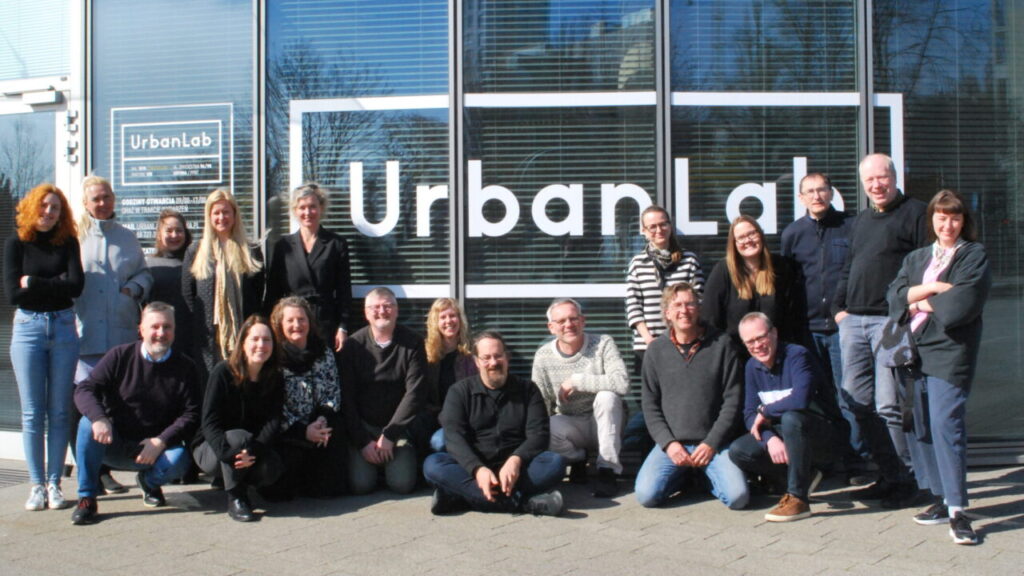
Most importantly, PCP creates momentum that extends far beyond a single project. The solutions developed through the CCC PCP have the potential to grow from local pilots into tools adopted across cities and countries. Many PCP-driven innovations eventually enter the wider European market—helping to shape new standards, new services, and new business opportunities.
At NDPC, we are genuinely proud to have led and shaped this process, especially given how rare and pioneering PCPs still are in our region. Working closely with the six CCC cities and our international partners, we have helped open a new pathway for innovation procurement in the Baltic Sea Region, one that others can now build upon.
Contact person for the Creative Circular Cities project: Kristīne Līpiņa, kristine@ndpculture.org